
This is a guest blog-post by Dr Anouska Lester, a recent winner of the John Edward Kerry Prize. To accompany her post, we are running a sale on four plays originally performed by the Lord Admiral’s Men (A Knack to Know an Honest Man, The Downfall of Robert, Earl of Huntingdon, The Death of Robert, Earl of Huntingdon, and Captain Thomas Stukeley) and Collections, Volume 4, which includes material from Philip Henslowe’s Diary. For the next month you can buy these titles for £15 (non-members) or £5 (members). Please click on the titles to access the relevant pages in our online shop.
The Ghosts of Henslowe’s Inventories
In early 1598 Philip Henslowe set out to inventory the props and costumes of the Lord Admiral’s Men. The resulting lists provide valuable insights into the staging of early modern plays, including how to costume the supernatural: the inventories record ‘j gostes sewt’, ‘j gostes bodeyes’, and ‘j gostes crown’.1 None of these costumes survive to the present day, but neither do the original manuscripts of the inventories themselves, which were transcribed and printed by Edmond Malone in 1790 and then lost. ‘Ghosts’ also provide a means of thinking through the inventories as evidence: Eleanor Collins looks for ‘ghosts in the archive’, identifying transcriptions of Sir Henry Herbert’s ‘Office-Book’ as ‘ghosts’ of the original manuscripts, now lost.2 This post explores the ghostly remains of performance in Henslowe’s lost inventories and follows Collins’ model in suggesting that their documentary history can be understood as another form of ghosting.3
In the second part of the first volume of his edition of the Plays and Poems of William Shakspeare, Malone describes how, ‘Just as this work was issuing from the press, some curious Manuscripts relative to the stage, were found at Dulwich College, and obligingly transmitted to me from thence’.4 The ‘curious Manuscripts’ included the volume now known as ‘Henslowe’s “Diary”’. At apparently the same time, a selection of theatrical inventories was found ‘In a bundle of loose papers’. Malone decided to ‘extract’ from the manuscripts the sections that ‘appear[ed]’ to him ‘worthy of preservation’.5 Between Malone transcribing and printing the inventories in 1790, and the return of the ‘curious Manuscripts’ to Dulwich College after his death in 1812, they were lost. Like his transcriptions of the now-lost ‘Office Book’, these documents are the ‘ghosts’ of the earlier sixteenth-century manuscripts.
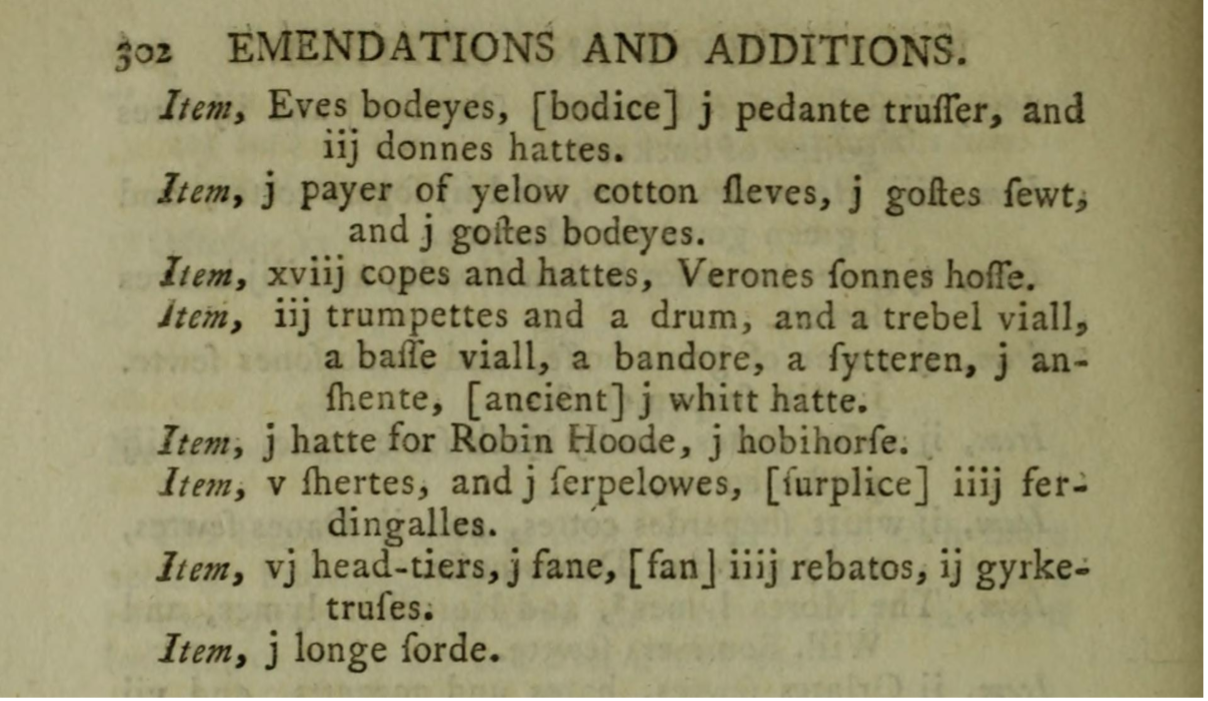
Transcription in Malone’s edition of The Plays and Poems of William Shakspeare, 1790, from Archive.org
Malone printed seven lists of properties, apparel, and books belonging to the Lord Admiral’s Men.6 Some of the items recorded relate to specific plays, such as the ‘whell & frame in the Sege of London’, or specific characters, like ‘Mercures wings’. Many items are defined not by their role in particular plays but by their material and visual qualities, such as an ‘ash coller satten doublett, lacyd with gold lace’. Two of the inventories, of ‘sewtes’ and ‘properties’, both dating to 10 March 1598, contain ghostly items: ‘j gostes sewt, and j gostes bodeyes’ and ‘j gostes crown’. These items may refer to a specific ghostly character, or a character archetype that is instantly recognisable from certain costumes or props, like the ‘poopes miter’ or the ‘fooles coate, cape, and babell’.7
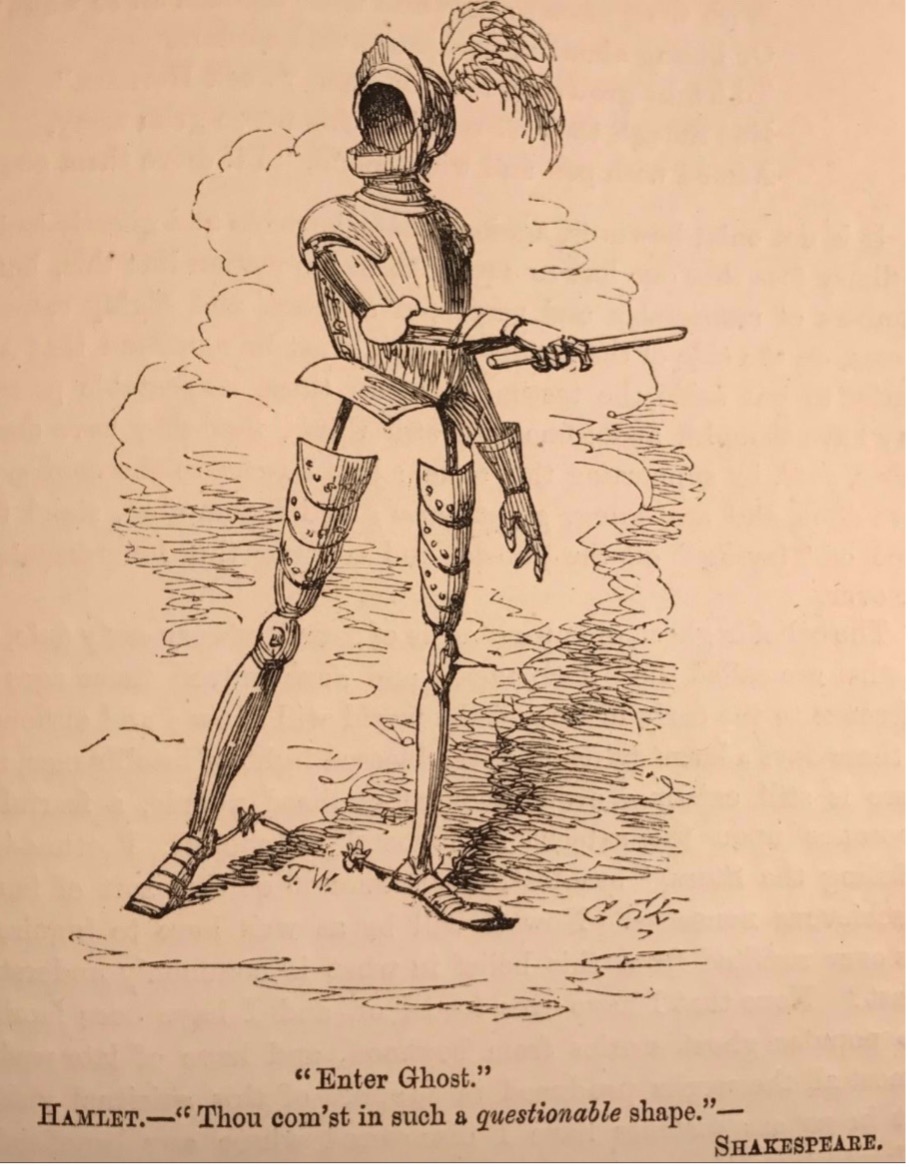
George Cruikshank, A Discovery Concerning Ghosts, 1864, Folger Shakespeare Library, Sh.Misc. 537 (CC0 1.0)
It is unclear precisely what would signify to an audience that a bodice, suit, or crown were ghostly. What differentiates a ‘gostes crown’ from a ‘playne’ one? Or an ‘Imperial’ one (of which the Admiral’s Men had three)? The most famous staged ghost wears the armour he was famed for in life: as Horatio says to Marcellus, ‘Such was the very Armor he had on, / When he the ambitious Norway combated’.8 Hamlet Senior’s appearance is unusual, though, and early modern ghosts are often pictured wearing the shrouds in which they were buried, as depicted in the woodcut from the ballad ‘The Midwives Ghost’ from 1680.9 Perhaps the ghostly suit and bodice were fashioned from the same kind of linen that would have been used for shrouds, and perhaps the crown was made to resemble the knot at the head of the shroud. However, the ‘bodeyes’ and perhaps the ‘sewt’ of the inventories are gendered in a way that a burial shroud is not.
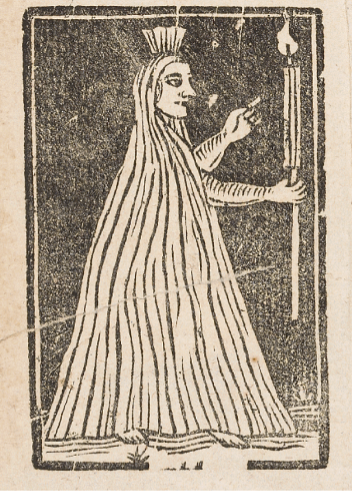
From A New Ballad of The Midwives Ghost, 1680, Magdalene College, Cambridge, Pepys Ballads, 2.145
via Broadside Ballads Online (CC BY-NC 4.0)
Edmund Gayton’s Pleasant notes upon Don Quixot (1654) describes a production of a ‘Spanish Tragedy’, telling the story of ‘Petrus Crudelis’, in which two scholars played ghosts:
these two Scholars were put out of their blacks into white long robes, their Faces meal'd, and Torches in their hands, and some flashes of Sulphur made at their entrance, just as they put their heads through the hangings of the Scene, comming out at two severall sides of the Stage, they shook so, and were so horribly affrighted at one anothers gashly lookes, that no force of those behind them, could get them to advance a foot forward toward the stage, or speak a word of their Parts; but there as they first stood, they stood for halfe an houre shaking, quaking, and staring one upon another, Insomuch, that they put the Auditory into such a shaking with laughing, that they had almost died with the excessive motions of the Diaphragme.10
In Gayton’s description, the representation of the ghosts is so convincing that the actors forget they are in a play. Their reaction nearly turns the audience into actual ghosts, as ‘they had almost died’ from laughter.
The materiality of staged ghosts, with their bodices, suits, and crowns, and their torches, sulphur flashes, and mealed faces, contrasts with the incorporeality they are intended to represent. Alice Rayner locates a ‘tension between the tangible materiality of an object and its representational function’ and Aoife Monks asks, ‘how can clothes, with their suggestions of flesh and presence, costume a figure that is characterised by bodilessness and absence?’11 This materiality is no longer accessible to us – the great majority of early modern costumes are mediated through text. Each item in the inventories is, as Matthew Steggle points out, ‘a representation of the thing named’ and not the thing itself.12 We can only make informed guesses about what the items might have looked like, how they were made, and when they were used. The ghost costumes, in their documentary form, have attained an incorporeality that was not possible in performance.
But each inventory is also ‘a representation of the thing named’ and not the thing itself, because the original manuscripts have not survived to the present day. Unlike the materiality of early modern stage ghosts, the inventories are intangible: texts without material context. Today we are reliant on Malone’s printed versions of his transcriptions, or more likely, edited versions of Malone’s printed transcriptions. In the face of such complexity, no wonder that we reach for metaphors in order to interpret the documents in front of us and how they got there. My PhD thesis pays particular attention to how the liveness of performance is mediated through documentation, which further complicates the status of both early modern texts and their transcript surrogates. When we think of performance as a live, embodied event, we might think of the documentary and material traces it leaves behind as its ghosts (or perhaps its corpses, if we’re in a morbid mood). A transcribed document of early modern performance is therefore doubly ghostly. We need to be practised paranormal investigators to navigate the mediated memories of performance and its lost documents.
- William Shakespeare, The Plays and Poems of William Shakspeare: In Ten Volumes: Collated Verbatim with the Most Authentick Copies, and Revised, with the Corrections and Illustrations of Various Commentators, ed. Edmond Malone, vol. 1 pt. 2 (London: H. Baldwin, 1790), 302–3. See also Anouska Lester, ‘“Gone and Loste”: Tracing Philip Henslowe’s 1598 Theatrical Inventories’, Medieval and Renaissance Drama in England, 37 (2024), 137–55. ↩︎
- Eleanor Collins, ‘Ghosts in the Archive: Edmond Malone, Craven Ord, and the Missing Texts of Henry Herbert’s “Office-book”’, Critical Quarterly 55.4 (2013), 30-41. ↩︎
- A similar idea is used in theatre and performance scholarship: Marvin Carlson’s The Haunted Stage: The Theatre as Memory Machine (Ann Arbor: University of Michigan Press, 2003) uses the metaphor of ghosting to describe how a production retains traces of performances that have gone before it in the re-use of narrative, spaces, actors, music, props, and costume. Ella Hawkins uses Carlson’s ghosting to interpret the relationship between Elizabethan and Jacobean clothing and present-day costume, arguing that the re-use of Jacobethan elements is an intentional and visible practice of spectral memory (Shakespeare in Elizabethan Costume: ‘Period’ Dress in Twenty-First Century Performance [London: Bloomsbury Arden Shakespeare, 2022], 156–64). Applying Hawkins’ and Carlson’s version of ghosting to Henslowe’s inventories, the ghost costumes haunt on multiple levels: firstly, through representing the supernatural on stage, and secondly, through the material and visual reminders of previous iterations of ghost characters. ↩︎
- Shakespeare, The Plays and Poems of William Shakspeare, 1 pt. 2:288. Of course, in Q1 Hamlet Senior’s ghost has a costume change from ‘Armor’ to ‘night gowne’. ↩︎
- Shakespeare, Plays and Poems, 1 pt. 2:289. ↩︎
- Shakespeare, Plays and Poems, 1 pt. 2:300–308. ↩︎
- Shakespeare, Plays and Poems, 1 pt. 2:301–4. ↩︎
- William Shakespeare, The Tragicall Historie of Hamlet Prince of Denmarke [Q1] (London: Printed [by Valentine Simmes] for N[icholas] L[ing] and Iohn Trundell, 1603), B2r. ↩︎
- Robert I. Lublin, Costuming the Shakespearean Stage: Visual Codes of Representation in Early Modern Theatre and Culture (Farnham: Ashgate, 2011), 44–45; Laura Sangha, ‘Horrid Ghosts of Early Modern England, Part II: Creeks, Screeks And… Bacon?’, The Many-Headed Monster (blog), 27 October 2016, para. 4. ↩︎
- Edmund Gayton, Pleasant Notes upon Don Quixot (London: William Hunt, 1654), 95. ↩︎
- Alice Rayner, Ghosts: Death’s Double and the Phenomena of Theatre (Minneapolis: University of Minnesota Press, 2006), 74; Aoife Monks, The Actor in Costume (Basingstoke: Palgrave Macmillan, 2009), 121. See also Lauren Robertson, Entertaining Uncertainty in the Early Modern Theater: Stage Spectacle and Audience Response (Cambridge: Cambridge University Press, 2023), 1-2. ↩︎
- Matthew Steggle, ‘Philip Henslowe’s Artificial Cow’, Medieval and Renaissance Drama in England 30 (2017): 66. ↩︎